
Modern businesses rely heavily on technology to manage operations, marketing, and customer relationships. However, many companies still operate with fragmented software systems that create more problems than solutions. Therefore, understanding The Hidden Cost of Fragmented Software: Why an All-in-One CRM is Non-Negotiable becomes essential for sustainable growth.
While multiple tools may seem flexible, they often lead to inefficiencies, data silos, and lost revenue opportunities. In contrast, an all-in-one CRM integrates everything into a unified ecosystem, enabling businesses to scale efficiently and deliver better customer experiences.
What Is Fragmented Software and Why Does It Exist
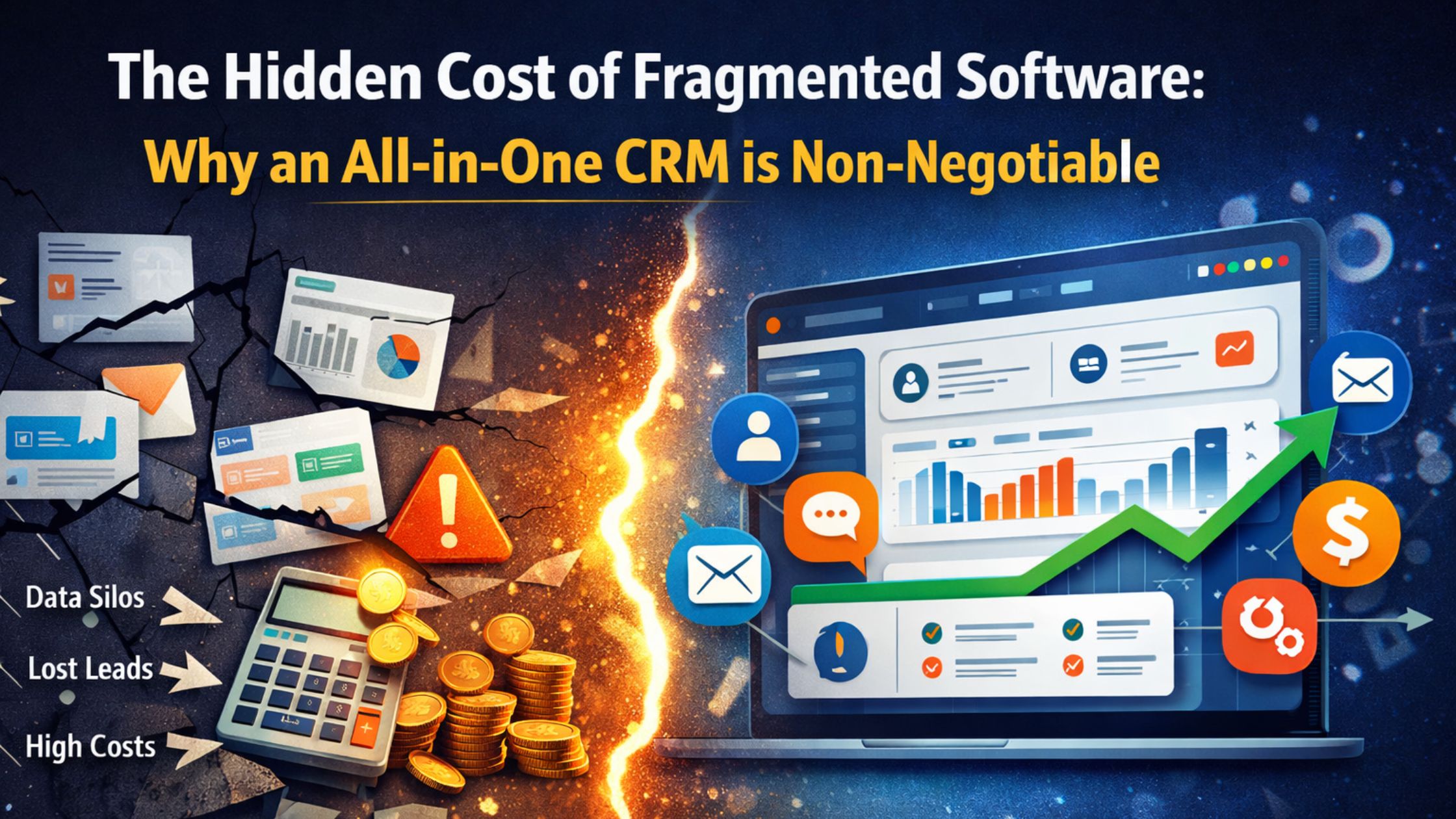
Fragmented software refers to the use of multiple disconnected tools to manage different business functions. For example, a company might use one platform for email marketing, another for lead tracking, and a third for customer support.
Initially, this approach feels convenient because businesses adopt tools as needs arise. However, over time, these systems fail to communicate effectively, which creates operational gaps. As a result, teams spend more time switching between tools instead of focusing on growth. Moreover, data becomes inconsistent, leading to poor decision-making.
The Hidden Financial Costs You Can’t Ignore
Many businesses underestimate the true cost of fragmented systems. While subscription fees may appear manageable, the indirect costs quickly accumulate.
1. Increased Operational Costs
Teams waste hours manually transferring data between systems every single week. Consequently, productivity declines, employee efficiency suffers, and operational costs increase across departments.
2. Data Inconsistency and Errors
Disconnected systems create duplicate or outdated data across platforms, departments, and internal teams. Therefore, sales and marketing teams struggle to rely on accurate insights for timely strategic decisions.
3. Lost Revenue Opportunities
When leads fall through the cracks due to poor integration issues and follow-up delays, businesses lose valuable potential customers. As a result, revenue growth slows significantly and conversion rates decline steadily over time.
4. Higher Maintenance Expenses
Managing multiple tools requires ongoing updates, integrations, troubleshooting, and constant technical oversight. This adds hidden IT costs over time and increases dependency on costly external support services.
Altogether, these hidden financial burdens prove that fragmented software weakens efficiency, profitability, and long-term business growth.
How Fragmentation Impacts Customer Experience
Customer experience directly influences business success. However, fragmented systems create disjointed interactions across touchpoints.
For instance, a customer may receive irrelevant emails because marketing data does not align with CRM records. Similarly, support teams may lack complete customer history, leading to frustrating interactions.
According to CRM insights, centralized systems improve customer engagement by unifying data and enabling personalized communication. Therefore, businesses using disconnected tools risk damaging their brand reputation. Learn more about The GMB Optimization System.
Why an All-in-One CRM Is Non-Negotiable
Now, let’s address the core idea behind The Hidden Cost of Fragmented Software: Why an All-in-One CRM is Non-Negotiable. An all-in-one CRM eliminates silos by combining essential business functions into a single platform. This includes:
- Lead and contact management.
- Sales tracking and automation.
- Marketing campaigns (email & SMS).
- Workflow automation.
- Customer support tools.
For example, platforms like those offered by Great North Digital provide integrated CRM systems that combine marketing automation, workflows, and communication tools in one place. As a result, businesses gain complete visibility over their operations.
Key Benefits of Switching to an All-in-One CRM
An all-in-one CRM offers practical advantages that help businesses operate smarter, faster, and more efficiently, with better coordination, stronger automation, and improved customer management.
- Centralized Data Management: All customer data lives in one system. Therefore, teams access accurate, real-time information without confusion.
- Improved Team Collaboration: Sales, marketing, and support teams collaborate on one platform, improving communication and workflow efficiency.
- Automation That Saves Time: Automation handles repetitive tasks such as follow-ups, lead nurturing, and reporting. As a result, teams focus on high-value activities.
- Better Decision-Making: With unified analytics, businesses gain actionable insights. Therefore, strategies become more data-driven and effective.
- Scalability for Growth: An all-in-one CRM grows with your business. Instead of adding new tools, you expand within the same ecosystem.
Together, these benefits make an all-in-one CRM a stronger foundation for long-term growth, operational clarity, better team performance, and more consistent customer experiences.
The Role of AI and Automation in Modern CRM
Today’s CRM systems go beyond simple data storage. They integrate AI and automation to enhance performance.
For example, AI-powered calling, chatbots, and marketing automation allow businesses to engage customers 24/7. Additionally, predictive analytics helps identify high-value leads.
According to industry trends, CRM adoption continues to grow due to AI integration and data-driven personalization. Therefore, businesses that fail to adopt modern CRM solutions risk falling behind competitors.
Fragmented Tools vs All-in-One CRM: A Clear Comparison
| Feature | Fragmented Software | All-in-One CRM |
| Data Management | Scattered & inconsistent | Centralized & accurate |
| Workflow Efficiency | Manual & time-consuming | Automated & streamlined |
| Customer Experience | Disconnected | Seamless & personalized |
| Cost Structure | Hidden & rising | Predictable & optimized |
| Scalability | Limited | High |
Clearly, the difference is not just technical—it directly impacts business growth and profitability.
When Should You Make the Switch
If your business experiences any of the following issues, it’s time to consider an all-in-one CRM:
- Teams rely on multiple tools for daily operations.
- Data inconsistencies affect decision-making.
- Leads are lost due to poor follow-up systems.
- Marketing campaigns lack coordination.
- Customer experience feels disconnected.
Therefore, switching early prevents long-term inefficiencies and revenue loss.
How to Transition Without Disruption
Transitioning to a unified CRM may seem challenging. However, a structured approach ensures smooth implementation.
- Audit Existing Tools: Identify all current software and their functions.
- Define Business Goals: Define goals like sales, automation, or experience.
- Choose the Right CRM: Choose a platform that fits and scales.
- Migrate Data Carefully: Ensure clean and accurate data transfer.
- Train Your Team: Provide proper onboarding to maximize adoption.
As a result, businesses can transition without disrupting operations, maintaining productivity, service quality, team alignment, and customer communication throughout the implementation process.
Conclusion
Fragmented software quietly wastes time, money, and growth opportunities. Therefore, businesses must recognize why an all-in-one CRM is no longer optional. It simplifies operations, improves customer management, centralizes data, and supports efficient growth. As a result, teams work better and deliver stronger customer experiences. Companies like Great North Digital highlight the value of integrated CRM solutions. Ultimately, unified platforms help businesses stay competitive, improve performance, and build long-term success more effectively.